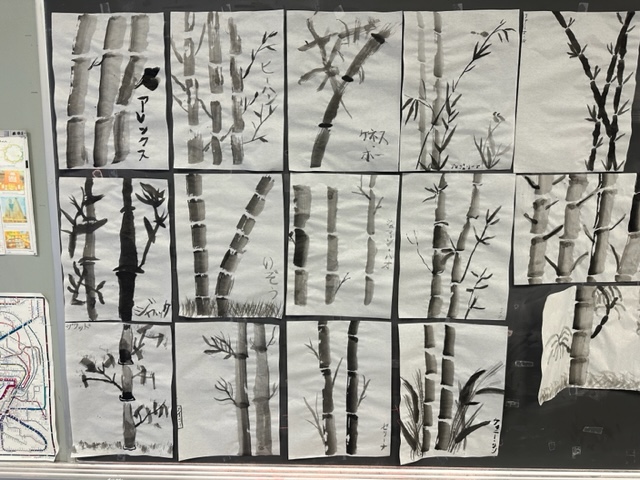
<p>Ms. Helinski's AP Japanese students learned a traditional Japanese art of Sumi-e. Here are some student share outs of their work!</p><p><b>Winnie Lin</b> - Sumi-e is a traditional Japanese way of creating art. In my piece, I had to diligently practice positioning my hands correctly while trying to create the perfect gradient. Though it was very difficult, it was also a very peaceful process that calmed my mind. I highly recommend everyone to try this experience!</p><p><b>Angelina Weng -</b> Sumi-e is a traditional Japanese style of ink painting. In AP Japanese, we attempted to create our own sumi-e masterpieces using varying dilutions of ink to achieve seamless gradients. Not only is there contrast between the black and white portions of the painting, but this also achieves a sense of harmony and balance between the filled and empty space. </p><p><b>Serena Louie -</b> For my <i>sumie</i>, or ink painting, I aimed to align with traditional Japanese artwork values of simplicity and balance. It was difficult at first, but eventually rewarding to learn skills such as painting ink gradients and aligning the brush at different angles depending on the stroke needed. Overall, this proved to be a very calming and insightful activity that I would love to try again!</p><p><b>Kayla Wang -</b> Making sumi-e, a monochrome painting composed of sumi ink and water, was an incredibly rewarding experience! We learned 5 techniques, applying them to create beautiful masterpieces. Although a lot of us were scared that we weren't going to make anything close to the traditional pieces, we ended up bonding over ink spills, splatters, and hyped each other up for our masterworks! I greatly appreciate the opportunity to have hands-on experience in immersing myself in Japanese art, and I hope other Language classes adopt this approach.</p><p><b>Rihanna Lu -</b> A quick and simple sumi-e, or ink painting, capturing bamboo. This painting largely incorporates chokuhitsu, a straight brush and line technique; although sakiguma (light to dark ink technique) or motoguma (dark to light ink technique) are not utilized, both are commonly seen in sumi-e.</p>